
Solid Security: What the Binance and Ledger Hacks confirmed

In five weeks, the two ways most people hold crypto both failed.
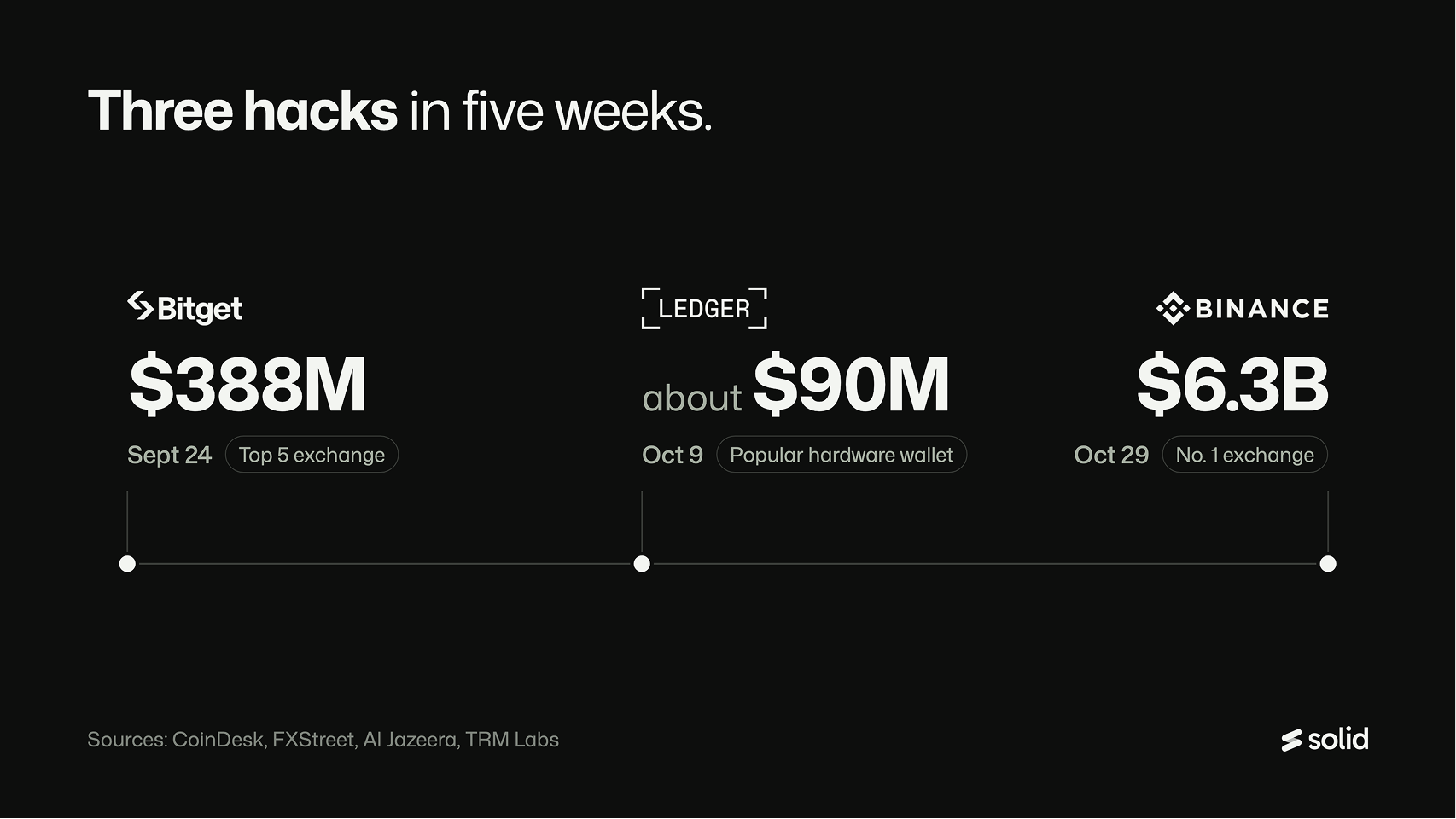
It started on October 9. Ledger users across Southeast Asia found their wallets empty, around $90 million gone. Ledger's secure chip was never broken. Devices bought from a reseller had been fitted with a hidden implant that read the 24-word recovery phrase off the screen and sent it to the attacker over a mobile network.
Then, on October 29, Binance lost about $6.3 billion, the largest crypto theft on record. The attack started on one engineer's laptop and ended with unauthorized withdrawals from the exchange's hot wallets. Binance says it will cover the losses. Bitget had lost $388 million the same way five weeks earlier.
A hardware wallet and the biggest exchange in the world. Two opposite answers to “who holds the keys”, one month, one lesson: the real question is what happens when a single thing fails.
Three ways to hold crypto, three single points of failure
- Exchanges and ETFs. You do not hold the keys. One compromised laptop was enough to drain Binance. A crypto ETF is a different flavour of the same thing: you own a share of a fund, a custodian owns the coins, and you can only hold the handful of assets someone decided to list. In both cases your money is a line in someone else's database.
- Hardware wallets. You hold the keys, and that is the whole problem. One device, one seed phrase, one screen. Lose the device and the phrase and the money is gone forever. Let anyone read the phrase, even a chip inside the box, and the money is gone immediately. There is no second approval, no rate limit, no one to call. And you cannot spend, borrow or earn with it without moving funds somewhere less safe.
- Browser wallets. Your keys live in an extension, next to every tab you open. One private key, sitting on one machine, signs everything. A fake site, a malicious extension or a clipboard swap is all it takes, and a single signature can drain everything. Solid keeps the same promise (your keys, your money) and removes both weak points: the key never sits on your device, and the account it controls has rules of its own.
How Solid security is built
Solid is non-custodial, and your money is protected in two layers.
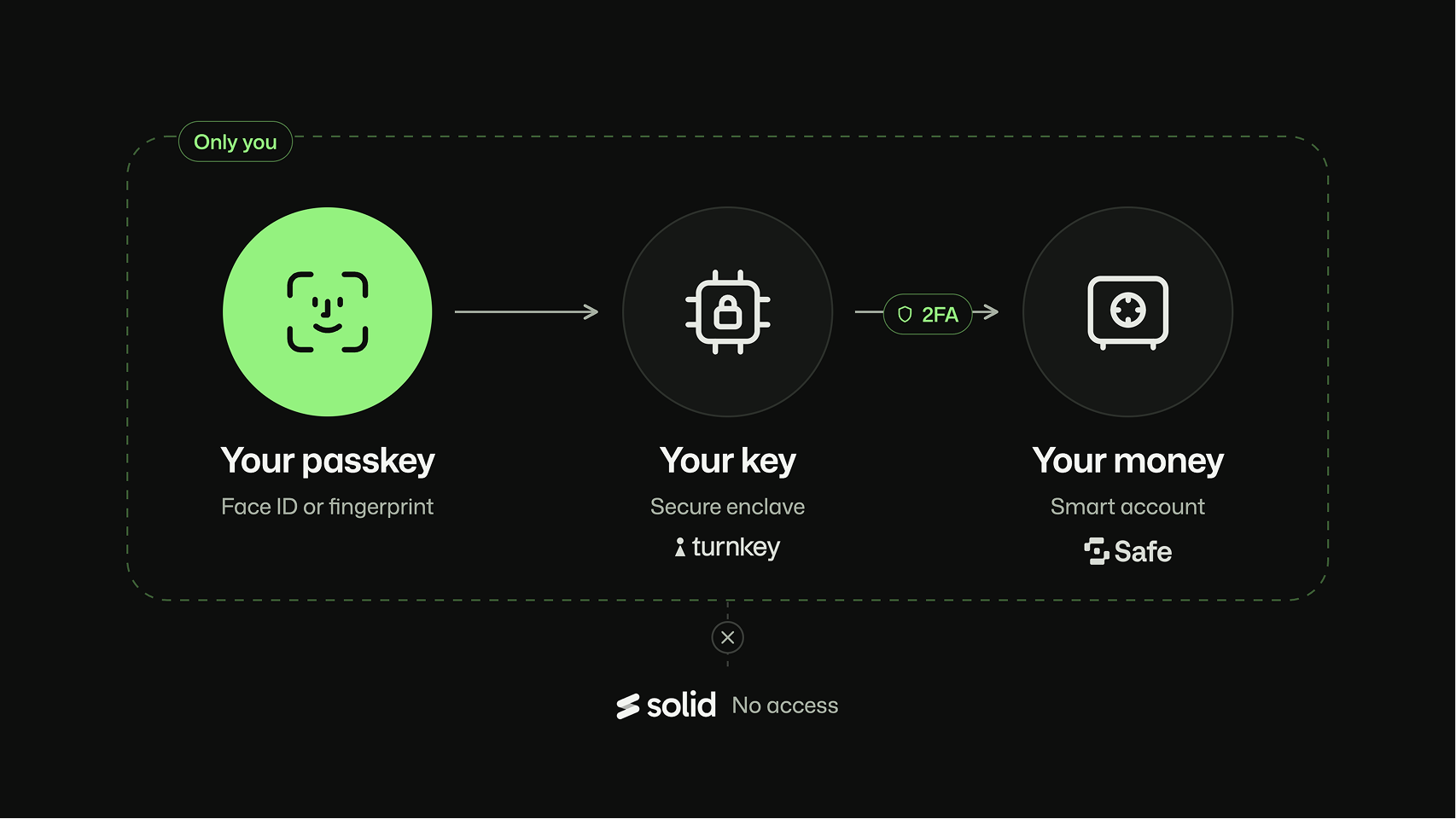
Layer 1: the key. In a browser wallet, your private key is a file on your computer. On Solid, it never exists anywhere it can be copied. It is created and used only inside Turnkey's secure enclaves, isolated hardware that nobody can open, and it signs only when your passkey says so: Face ID or your fingerprint, on your device. Solid never sees it. Not our team, not an attacker who gets into our systems.
Layer 2: the account. Your money does not sit behind that key directly. It sits in a Safe smart account on Fuse, the smart account standard institutions and DAOs use for their own treasuries. A smart account is a contract with rules, so it can protect you in ways a plain key never could. It is also what makes the next part of this article possible.
On top of that, Solid adds the protections a seed phrase cannot give you:
- Passkeys instead of passwords. Nothing to type, nothing to phish, nothing to reuse.
- 2FA on sensitive actions. Changing security settings or moving large amounts takes a second check.
- A card, yield and borrowing on the same account, so your money never has to leave the safe place to be useful.
Recoverable, without a seed phrase and without trusting us
This is where Solid breaks the usual trade-off. A hardware wallet is unrecoverable by design. An exchange is recoverable because the exchange owns everything. Solid is recoverable because you own everything.
Lose your phone and you restore access with the recovery email on your account. The recovery flow runs through Turnkey, and the credential is encrypted so that neither Solid nor your email provider can read it. You then create a new passkey on your new device and you are back in. There is no 24-word phrase to write down, photograph or lose.
Support can walk you through it. Support cannot do it for you. Nobody at Solid can create a passkey on your behalf, change the key that controls your funds, or sign a transaction. If you are the owner, you get back in. If you are not, there is nothing on our side to take.
Safer than a hardware wallet. Easier than a bank.
The last month has made the case better than we could. Custodians fail at the company. Hardware wallets fail at the person. Solid is built so that neither failure reaches your money.
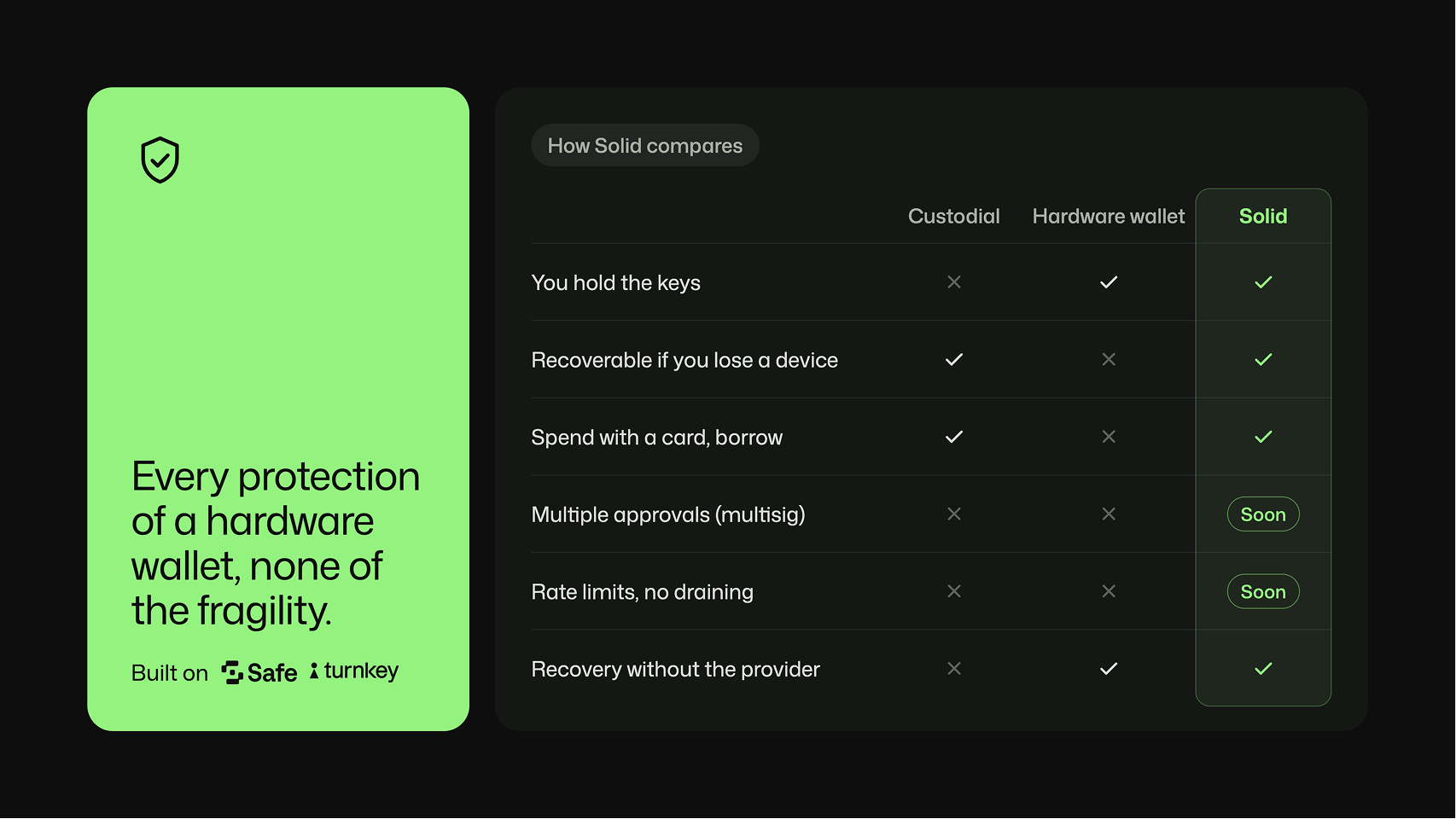
Against a hardware wallet, you keep the keys and lose the fragility: no seed phrase to protect, no device that takes your money with it, and an account you can actually spend from, earn on and borrow against.
Against a bank, you keep the convenience and lose the middleman. A bank is recoverable because the bank owns the ledger, and the same ownership lets it freeze your account, cap what you can send, hold a transfer for review or ask what the money is for. On Solid there is nobody in the middle. The account is yours on-chain, the key is yours in the enclave, and a transaction goes through when you sign it, whatever the amount. Solid cannot block a withdrawal any more than it can make one.
Already better. Going further.
Because a Solid account is a Safe smart account, you can set the rules that protect it instead of having them imposed on you. Next up:
- Limits you set yourself. A daily or per-transaction cap you choose, so even a stolen device cannot drain the account in one go.
- Hardware-grade passkeys, required above a balance you decide.
And there is one more piece we are not ready to show yet.
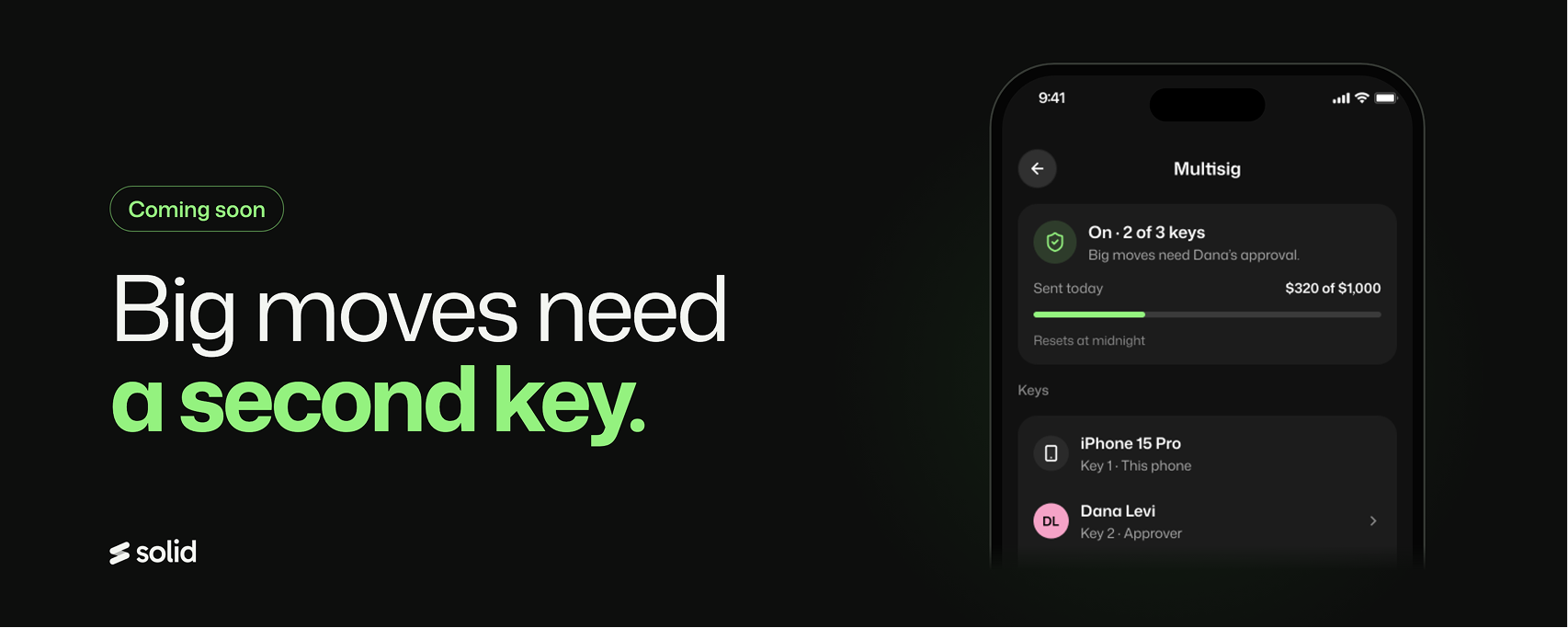
Your phone lights up: someone is trying to make a big move from an account you protect, and nothing leaves until a second person says yes. It is how banks guard their own vaults, rebuilt for an account that belongs to you. More very soon.
Binance could not stop one laptop. Ledger could not stop one chip. In both cases the protection lived in one place, and when that place fell, everything behind it fell too.
That is the model we are leaving behind. On Solid the protection already lives with you: your passkey, your device, your key in an enclave nobody else can open.
The next step is to let you write the rules too, so that no single thing can move everything at once. Not a laptop, not a chip, not a stolen phone. Stay tuned.
Sources: Binance hack: CoinDesk, Al Jazeera, TRM Labs. Bitget hack: CoinDesk and FXStreet coverage. Ledger implant: CoinDesk. Email recovery design: Turnkey.